
Seville travel guide
Seville
Seville's historic center packs the Real Alcázar, Seville Cathedral and the Giralda, and the former Jewish quarter of Santa Cruz within a short walk of each other. Triana across the river, Plaza de España and Macarena's city walls each add a genuinely different layer beyond the core sights, and Córdoba and Ronda are each a real day trip away.
A first visit usually centers the Alcázar, Cathedral and Santa Cruz, plus one evening of flamenco; a longer stay adds Triana, Plaza de España and Metropol Parasol, and a week or more makes room for a genuine Córdoba or Ronda day trip.

Find your Seville experience
Explore Seville Before You Book
Take a virtual drive or walk, then find tours and tickets for the places you like.

Activities
Featured activities in Seville



Prices at a glance
What we sell today and what recent flight searches found. No hotel prices; nothing here is a trip total.
- Tours and tickets in Sevillefrom US$15.98
Live from Viator when this page loaded · per adult · changes by date.
Top experiences
Top experiences in Seville
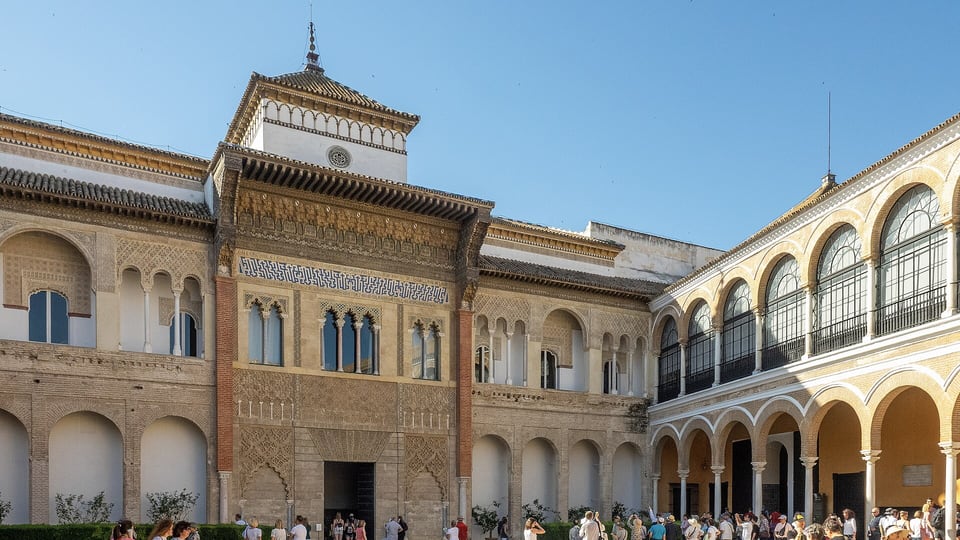
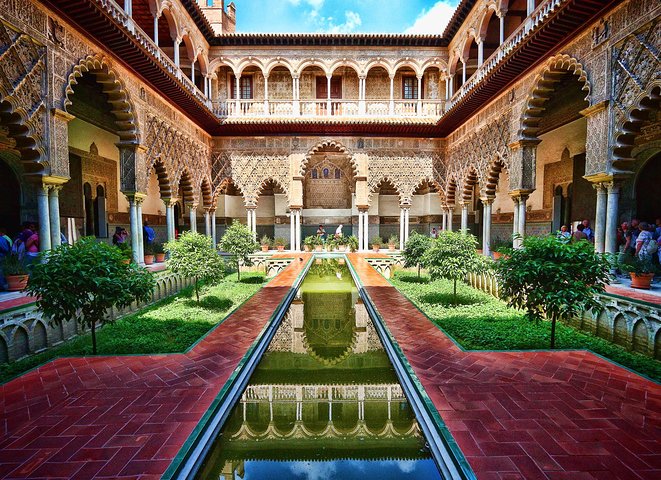
Real Alcázar de Sevilla
The Real Alcázar has been a UNESCO World Heritage Site since 1987 (jointly with the Cathedral and the Archivo de Indias) and its upper floors are still used as a royal residence by the Spanish royal family when in Seville, administered by Patrimonio Nacional. Its Mudéjar palace, built for Pedro I 1364-1366, sits atop Almohad-era construction from around 1150-1169, itself built over a 913-914 fortification.
Best for: Travelers who want a real working royal palace with over a thousand years of continuous building, not a single-era museum piece · Area: Historic center, adjoining the Cathedral and Santa Cruz
Plan for Part of the fifth season of Game of Thrones -- and part of the sixth -- was filmed here as the Water Gardens of Dorne, using the Hall of Ambassadors, Mercury's Pond, the Baths of Lady María de Padilla and the palace gardens. Peak-season crowds now include fans tracking specific filming spots, not only architecture visitors.
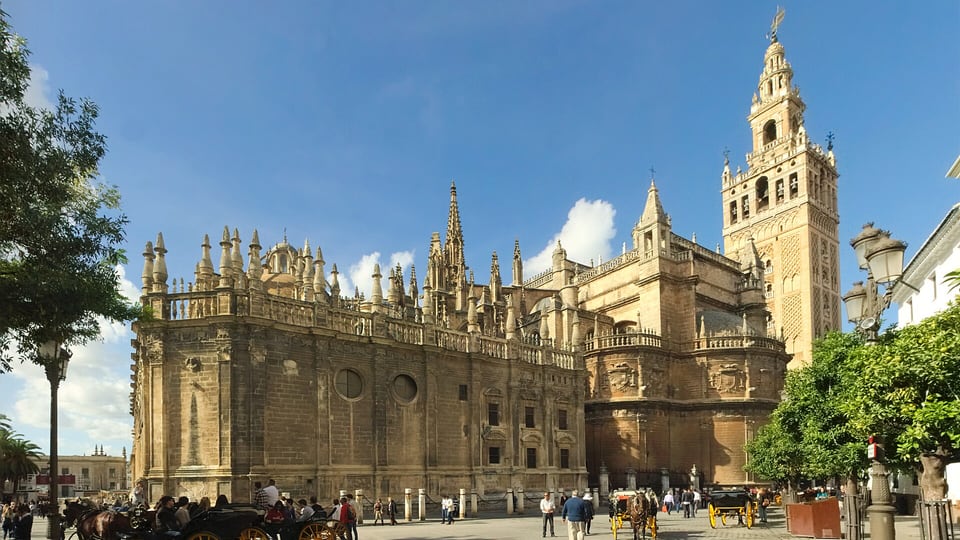
Seville Cathedral and the Giralda
UNESCO describes Seville Cathedral as the largest Gothic building in Europe; construction began in 1402 and the main structure was finished by 1506-07. The Giralda bell tower began as the minaret of the Almohad mosque on this site, built from 1184 under architect Ben Ahmad Baso and completed in 1198, then converted to a bell tower after the 1248 conquest.
Best for: Travelers who want the real scale of the largest Gothic building in Europe and 800 years of Islamic-to-Christian architectural layering in one tower · Area: Historic center, Plaza Virgen de los Reyes
Plan for The cathedral's tomb attributed to Christopher Columbus is a genuine draw, but honestly carries real scholarly uncertainty: a 2024 University of Granada DNA study concluded the remains match Columbus's relatives. The Dominican Republic's competing Santo Domingo claim has never been independently tested, so "his tomb" is accurate but not settled beyond doubt.
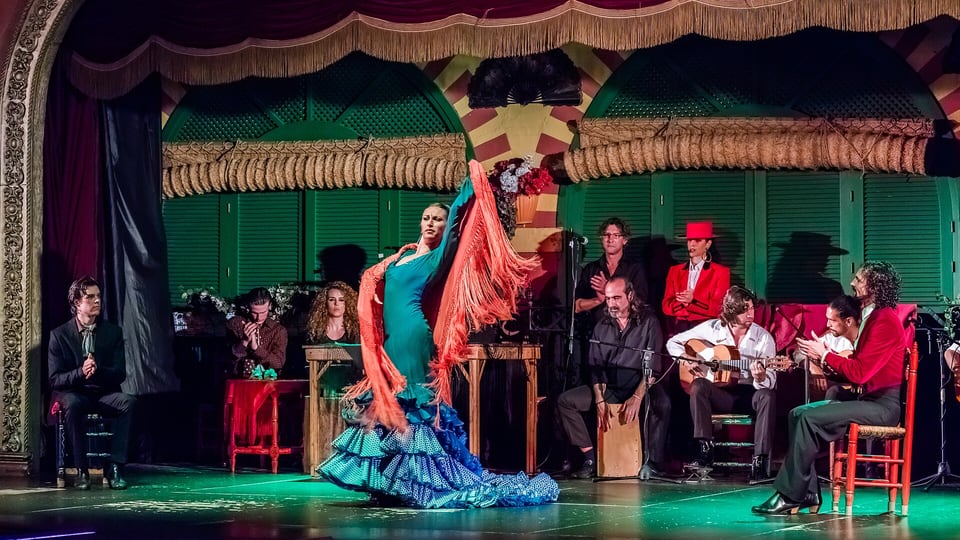
Flamenco: a tablao or a peña, not just a show
UNESCO inscribed flamenco as an Intangible Cultural Heritage of Humanity on 16 November 2010. Seville's own role is documented: Silverio Franconetti, a pioneering singer, opened the city's first flamenco café cantante in 1881, launching the professional-venue tradition tablaos descend from today.
Best for: Travelers who want to understand the real difference between a polished tourist-oriented tablao and a rawer, later-starting peña where locals actually go · Area: Triana and the historic center both have venues; peñas cluster more in Triana
Plan for A tablao is reliably bookable, professionally staged and beginner-friendly; a peña is more authentic and spontaneous but starts later (rarely before 11 p.m.), is less predictable and is harder to walk into without some local knowledge.
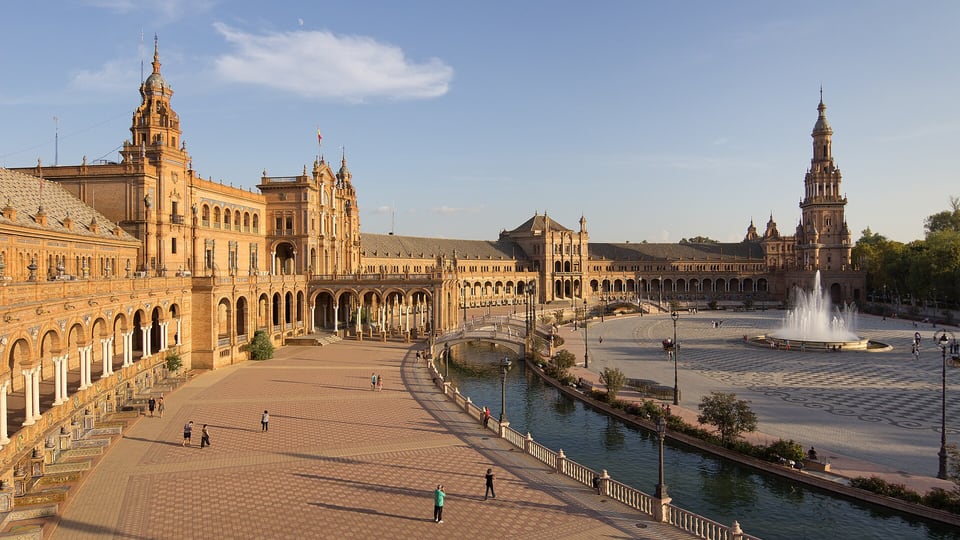
Plaza de España
Built in 1928 as the centerpiece of the 1929 Ibero-American Exposition, architect Aníbal González designed a half-circle blending Spanish Renaissance Revival, Baroque Revival and Neo-Mudéjar styles, with four bridges symbolizing Spain's medieval kingdoms and 48 tiled alcoves, one for each Spanish province.
Best for: Travelers who want the real 1929 Exposition history behind a plaza many only recognize from film · Area: Parque de María Luisa, southern edge of the historic center
Plan for It doubled as Naboo's capital Theed in Star Wars: Episode II - Attack of the Clones (2002) and appeared in Lawrence of Arabia (1962), so parts of it now draw film-location visitors specifically, on top of its own real Exposition-era architecture and history.
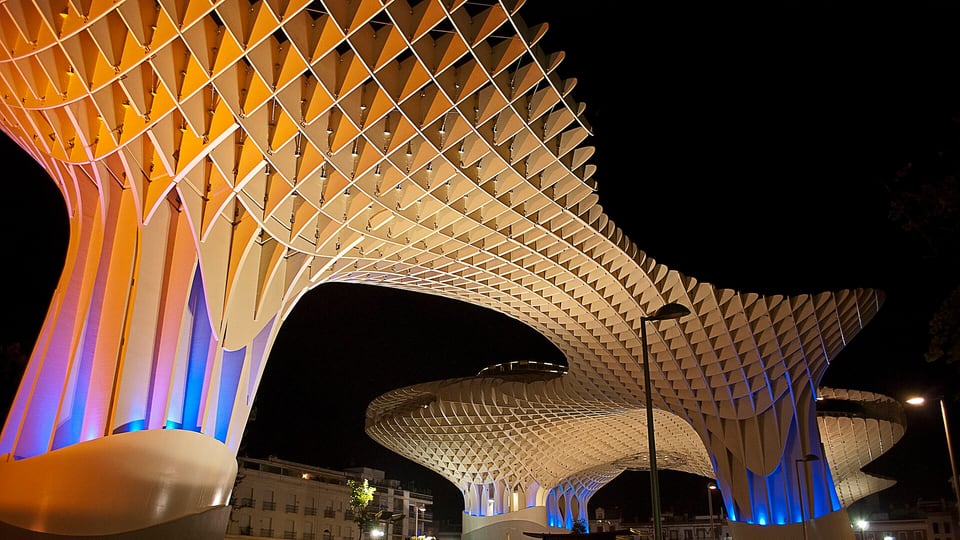
Metropol Parasol (Las Setas)
Designed by German architect Jürgen Mayer H. after winning a competition among 65 entries, this 150-by-70-meter, 26-meter-tall structure was built from 3,500 cubic meters of micro-laminated Finnish pine. Construction began in 2005 and finished in April 2011, years behind its original 2007 target, with the project's cost roughly doubling from its original budget.
Best for: Travelers who want to see Seville's contemporary side and understand why a modern wooden structure sits atop Roman and Moorish ruins · Area: Plaza de la Encarnación, historic center
Plan for The structure sits directly above Roman and Moorish archaeological remains, now an on-site museum, so a visit here pairs 21st-century architecture with genuinely ancient ruins in the same building, not two separate stops.
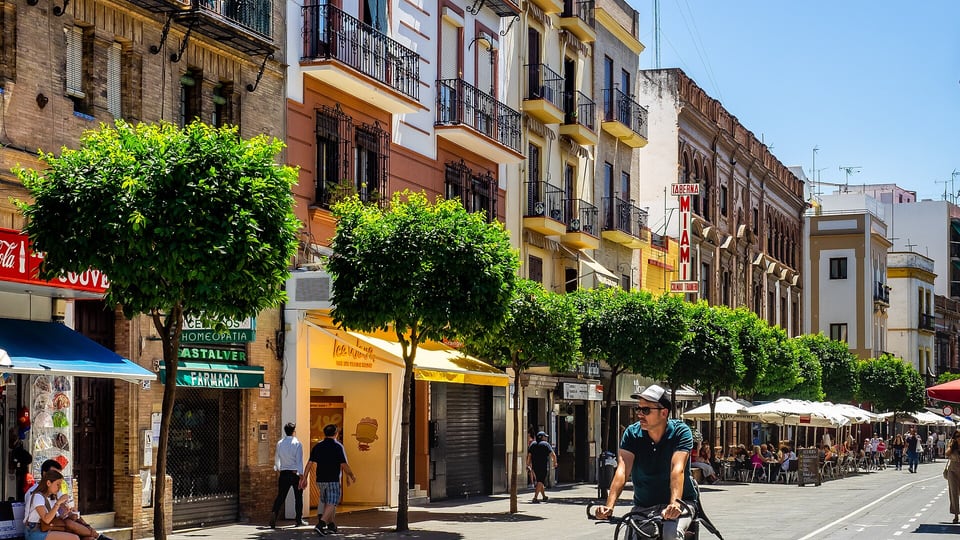
Triana: ceramics, flamenco roots and the bridge across the river
The Puente de Isabel II -- Triana's iconic bridge, popularly known as the Puente de Triana -- was built between 1845 and 1852 by engineers Gustavo Steinacher and Ferdinand Bennetot and gained national monument status in 1976. The neighborhood's traditional pottery and tile industry and deep flamenco culture predate the bridge itself.
Best for: Travelers who want Seville's working-class riverside identity and ceramics/flamenco roots away from the historic-center tourist core · Area: West bank of the Guadalquivir River, across from the historic center
Plan for Triana trades the historic center's dense monument-per-block density for a more local, lived-in feel -- fewer single "must-see" sites, more genuine neighborhood atmosphere, markets and flamenco peñas.
See Triana: ceramics, flamenco roots and the bridge across the river tours
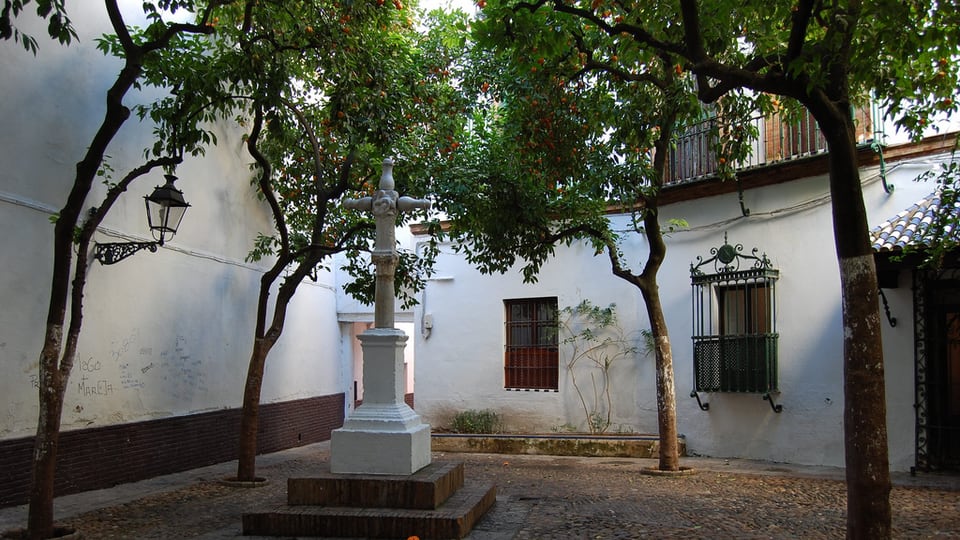
Barrio Santa Cruz, the former Jewish quarter
After Ferdinand III's 1248 conquest, Seville's Jewish population -- second in size on the Iberian Peninsula only to Toledo's -- was concentrated into this single quarter. The 1492 Alhambra Decree expelled Spain's Jewish population, after which the neighborhood declined before 18th-century renewal, and the surviving Santa María la Blanca church is a converted 14th-century Mudéjar synagogue.
Best for: Travelers who want the real, specific history behind Seville's most-photographed maze of narrow streets, not just "pretty alleys" · Area: Adjoining the Cathedral and Alcázar, historic center
Plan for Santa Cruz's narrow streets draw heavy day-tripper traffic by midday, so an early morning or early evening visit sees the quarter's real character far better than a midday walk-through.
Feria de Abril, if your dates line up
Dating to 1846 as a livestock market -- the first fair held 18 April 1847 -- the April Fair became a full festive celebration by the 1920s. It now draws roughly 5 million visitor-visits across its week, including around 850,000 on the single busiest Friday night, across more than 1,000 decorated casetas (tents) in a 450,000-square-meter fairground used since 1973.
Best for: Travelers whose trip lands two weeks after Easter, wanting sevillanas dancing and a real, huge local festival · Area: Real de la Feria fairground, between Los Remedios and Tablada
Plan for This is genuinely date-locked -- it runs six days starting two weeks after Easter each year -- so it only belongs on an itinerary that happens to fall in that specific spring window, not a general recommendation.
Day trips: Córdoba and Ronda
Córdoba (home to the Mezquita-Catedral) and Ronda (built around its dramatic gorge) are each close enough for a real single-day round trip from Seville. Current Viator inventory confirms both are genuinely bookable as day tours, including a combined "three cities" itinerary covering Córdoba, Ronda and the Andalusian white villages in one day.
Best for: Travelers with 5+ days who want Andalusia beyond Seville itself, without committing to an overnight stay elsewhere · Area: Córdoba and Ronda, both within day-trip range of Seville
Plan for A combined "three cities in one day" itinerary covers more ground but spends much of the day on the road; a single-destination day trip to just Córdoba or just Ronda allows more actual time at that one place.
Plan two, four or seven-plus days in Seville
Two to three days: the historic-center essentials
Pick this length for the Real Alcázar, Cathedral & Giralda, Santa Cruz and one evening of flamenco.
These four fit comfortably without rushing, especially if timed around the real midday heat in summer.
The trade-off This length skips Triana, Plaza de España and any day trip entirely, so it suits a highlights-only visit or a stop within a longer Andalusia trip.
Four to five days: add Triana, Plaza de España and Macarena
Pick this length once Triana's ceramics and flamenco culture, Plaza de España and Metropol Parasol, and Macarena's city walls all matter.
This spreads the historic center's dense sightseeing across more days and adds real neighborhoods beyond the core.
The trade-off This length still doesn't reach outside Seville itself; a Córdoba or Ronda day needs the longer stay below.
A week or more: add a real Córdoba or Ronda day trip
Pick this length to add a genuine day trip to Córdoba or Ronda -- or the combined multi-city day -- on top of an unhurried pace through the rest of the city.
A week allows Andalusia beyond Seville itself without an overnight stay elsewhere.
The trade-off This length costs more overall time than a city-only trip, but it's the only one that comfortably reaches outside Seville.
Sources
checked 2026-09-24. Recommendations are editorial judgements based on the cited sources below.
- Wikipedia: Alcázar of Seville
- Wikipedia: Triana, Seville
- The booking platform: Seville destination mapping d556
Choose a Seville base and explore nearby
Centro/Santa Cruz: a base for the Cathedral, Alcázar and Santa Cruz within a short walk
Consider this base for the Real Alcázar, Cathedral & Giralda and Santa Cruz's streets all within walking distance.
This puts Seville's three most-visited sites within a short walk of each other, at the cost of the city's most crowded midday streets.
The trade-off Choosing Centro/Santa Cruz means accepting real crowds and the least shade in summer, a fair trade for most first visits given the walking-distance convenience.
Triana: a base for a more local, riverside feel
Consider Triana for direct access to ceramics workshops, flamenco peñas and Calle Betis's riverside bars, a short walk across the 1845-1852 bridge from the historic center.
This trades the historic center's monument density for a genuinely local, lived-in neighborhood.
The trade-off Triana has fewer single must-see sites than Centro, a reasonable trade for travelers prioritizing local atmosphere.
Macarena or Alameda de Hércules: a base for the city walls and real nightlife
Consider Macarena or the adjoining Alameda de Hércules when the Almohad-era city walls, the 1949 Basílica de la Macarena and Seville's genuine (not tourist-priced) tapas-bar nightlife matter more than proximity to the Cathedral.
This area's 1574 promenade and preserved medieval walls give it a genuinely different, quieter-by-day character than the historic core.
The trade-off Basing here means a longer walk to the Cathedral and Alcázar, a worthwhile trade for travelers prioritizing the walls and nightlife.
Sources
checked 2026-09-24. Recommendations are editorial judgements based on the cited sources below.
Airport, safety and getting around
Seville Airport (SVQ, ICAO LEZL), also known as San Pablo Airport, sits roughly 10km east of the city center and handled just over 9 million passengers in 2024, making it Spain's sixth-busiest inland airport and a base for low-cost carriers Vueling and Ryanair.
The historic center, Triana and Santa Cruz are all walkable from each other; Seville's tram and bus network cover the wider city, and Santa Justa station in Nervión is the main hub for trains to Córdoba, Madrid and Ronda.
Seville is a large, genuinely safe tourist city, but the UK Foreign, Commonwealth & Development Office's general Spain guidance -- to be alert to street crime, since thieves use distraction techniques -- applies here as across Spain's tourist cities. No Seville-specific warning exists, so ordinary vigilance in crowds is the real precaution.
Real, honest heat planning matters as much as any single sight: with July-August highs regularly above 36°C and a verified 46.6°C record, many locals and repeat visitors shift sightseeing to morning and early evening and treat the early afternoon as a rest period, not a sign of low energy.
Best time to visit
Winter (December-February)
Seville's wettest, mildest season, with daytime highs typically in the mid-teens Celsius -- genuinely the most comfortable season for walking the historic center all day without heat management.
- Crowds
- Low
Spring (March-May)
The city's most in-demand season: Semana Santa (Holy Week) and, two weeks after Easter, the week-long Feria de Abril both fall here, so accommodation books out and prices rise well ahead of both events.
- Crowds
- High
Notable events
- Semana Santa (Holy Week)
- Feria de Abril -- roughly 5 million visitor-visits across its week
Summer (June-August)
Seville's real extreme: July and August average highs above 36°C, and the airport's weather station has reliably recorded 46.6°C (23 July 1995) -- among the hottest major metro areas in continental Europe, so summer sightseeing genuinely needs to shift to mornings and evenings.
- Crowds
- Varies by event and attraction
Autumn (September-November)
A genuine shoulder season as the summer heat eases through September into more comfortable October-November temperatures, with fewer crowds than spring's festival season.
- Crowds
- Varies by event and attraction
Food, tapas bars and local life
Tapas' own origin is genuinely contested rather than settled: competing legends credit 13th-century King Alfonso X ordering taverns to serve a snack alongside wine, and a 19th-century Cádiz waiter covering a glass with ham to keep out sand for King Alfonso XIII. Neither story is specifically tied to Seville, and the honest answer is that the dish format's exact origin isn't verifiable.
What is verifiable is Seville's own tapas-bar history: El Rinconcillo, founded in 1670, is documented by its own owners as the city's oldest continuously run bar. It was purchased by the De Rueda family in 1858 and expanded to its current linked-building form by 1897 -- a real, dated anchor for the city's tapas-bar culture, whatever the wider dish's true origin.
City profile
- Population (City of Seville (municipality), 2024; the wider metropolitan area is a distinct, broader figure of roughly 1.5 million, 2024): 686,742
Seville was founded as the Roman city of Hispalis. After the Islamic conquest of the Iberian Peninsula, it became known as Ishbiliya, the Arabic name from which "Seville" descends.
Ferdinand III of Castile besieged the city for fifteen months before it surrendered on 23 November 1248, bringing it under Christian rule and ending more than five centuries of Islamic governance.
In 1503, Seville became headquarters of the Casa de Contratación, the crown's monopoly authority over Spanish trade with the Americas, making the city Europe's gateway to the New World until the Guadalquivir's silting reduced the port's viability in the early 1600s.
Seville hosted two major world expositions -- the 1929 Ibero-American Exposition, which produced Plaza de España, and the 1992 Universal Exposition (Expo '92) -- and today serves as the capital of the Andalusia autonomous community.
Famous for:
- The Real Alcázar has held UNESCO World Heritage status since 1987, jointly with the Cathedral and the Archivo de Indias. Its upper floors are still used as a royal residence by the Spanish royal family when in Seville, administered by Patrimonio Nacional -- a genuinely working palace, not only a museum.
- UNESCO describes Seville Cathedral as the largest Gothic building in Europe. Construction began in 1402 and the main Gothic structure was completed by 1506-07, after which the tomb attributed to Christopher Columbus was placed inside.
- UNESCO inscribed flamenco as an Intangible Cultural Heritage of Humanity on 16 November 2010. Seville's own role in professionalising the art form is documented: singer Silverio Franconetti opened the city's first flamenco café cantante in 1881.
- Plaza de España was built in 1928 as the centerpiece of the 1929 Ibero-American Exposition, designed by architect Aníbal González, and has since served as a filming location for Lawrence of Arabia (1962) and Star Wars: Episode II - Attack of the Clones (2002).
What makes a Seville visit worthwhile
Seville's summers are not a mild inconvenience: July and August average highs above 36°C, and the city's airport weather station has reliably recorded 46.6°C, on 23 July 1995 -- honestly among the hottest major metro areas in continental Europe, so a June-August visit means planning around the early afternoon rather than pretending the heat is manageable at midday.
Seville is a large, safe tourist city, but it is not exempt from the pickpocketing and distraction-theft that the UK Foreign, Commonwealth & Development Office flags generally for crowded Spanish tourist areas. No Seville-specific warning exists in that advice; ordinary vigilance around bags and pockets in crowded sites like the Cathedral queue or Triana market is the real precaution, not a special local risk.
Seville Cathedral's tomb is genuinely presented as Christopher Columbus's resting place, and a 2024 University of Granada DNA study concluded the remains match his known relatives. Real uncertainty persists, though: the Dominican Republic, which also claims his remains in Santo Domingo, has never allowed the independent testing Spain's team says would settle the question.
- Plan by trip type
- Real Alcázar & Cathedral · Santa Cruz · Triana across the river · Plaza de España & Metropol Parasol · Macarena's city walls · Day trips to Córdoba and Ronda
- Good first stay
- 2-3 days for the historic core and one evening of flamenco, 4-5 days adding Triana, Plaza de España and Macarena, a week+ with a Córdoba or Ronda day trip
- Climate constraint
- A real Mediterranean extreme: mild winters (Dec-Feb) but July-August highs above 36°C and a reliably recorded 46.6°C -- among Europe's hottest cities
- Main gateway
- SVQ airport (San Pablo), roughly 10km east of the center; the historic core is walkable, with tram and bus covering the rest
Planning your Seville visit: FAQs
Is Christopher Columbus's tomb in Seville Cathedral genuinely his remains?
Seville Cathedral's tomb is widely presented as Columbus's resting place, and a 2024 University of Granada DNA study concluded the remains match his known relatives. Real uncertainty remains, though: the Dominican Republic, which also claims his remains in Santo Domingo, has never allowed the independent testing Spain's researchers say would settle the question definitively.
How hot does Seville actually get in summer?
Genuinely extreme: July and August average highs above 36°C, and the airport's weather station has reliably recorded 46.6°C on 23 July 1995 -- among the hottest major metro areas in continental Europe, so plan sightseeing for mornings and evenings in June-August.
Is Seville safe, and should I worry about pickpockets?
Seville is a large, safe tourist city with no Seville-specific FCDO warning, but the UK government's general Spain guidance on distraction theft and pickpocketing in crowded tourist areas applies here as it does across the country -- ordinary vigilance, not special local risk.
What's the real difference between a flamenco tablao and a touristy show?
A tablao is a professionally staged, reliably bookable show aimed at visitors; a peña is a more local, spontaneous venue that rarely starts before 11 p.m. and is rawer and less predictable -- both are real flamenco, but they are genuinely different experiences.
Can I actually see the rooms the Spanish royal family uses at the Real Alcázar?
The upper floors are a real, still-used royal residence administered by Patrimonio Nacional, and parts are open to visitors on a separate admission on top of the main palace ticket -- this is a working palace, not only a historical exhibit.
Are Córdoba and Ronda worth a day trip from Seville?
Yes for both, per current bookable inventory: Córdoba's Mezquita-Catedral and Ronda's gorge-spanning bridge are each a real single-day round trip. A combined multi-city day tour covering both plus the Andalusian white villages also exists, though it trades depth at any one stop for covering more ground.
Make your Seville plans
Compare tours, tickets and activities in Seville →
Choose your departure market and search flights to Seville from the Mubboo Flights homepage.
Compare flights ↗Sources
Latest source check: .
Show all 23 sources
- Wikipedia — Seville (checked 2026-09-24)
- Wikipedia — Alcázar of Seville (checked 2026-09-24)
- Wikipedia — Seville Cathedral (checked 2026-09-24)
- Wikipedia — Flamenco (checked 2026-09-24)
- Wikipedia — Plaza de España, Seville (checked 2026-09-24)
- Wikipedia — Metropol Parasol (checked 2026-09-24)
- Wikipedia — Triana, Seville (checked 2026-09-24)
- Wikipedia — Santa Cruz, Seville (checked 2026-09-24)
- Wikipedia — Feria de Abril (checked 2026-09-24)
- Wikipedia — Macarena, Seville (checked 2026-09-24)
- Wikipedia — Alameda de Hércules (checked 2026-09-24)
- Wikipedia — Nervión, Seville (checked 2026-09-24)
- Wikipedia — Seville Airport (checked 2026-09-24)
- Wikipedia — Tomb of Christopher Columbus (checked 2026-09-24)
- Wikipedia — Tapas (checked 2026-09-24)
- GOV.UK — Spain travel advice: safety and security (checked 2026-09-24)
- Archaeology Magazine — DNA analysis confirms Christopher Columbus' remains in Seville (checked 2026-09-24)
- Euronews — New study solves mystery of Christopher Columbus origins and resting place (checked 2026-09-24)
- Game of Thrones Spain — Alcázar of Seville filming location (checked 2026-09-24)
- Tablao Flamenco Andalusí — Authentic Flamenco vs Tourist Trap in Seville (checked 2026-09-24)
- El Rinconcillo — history (checked 2026-09-24)
- Visita Sevilla — Basílica y murallas de la Macarena (checked 2026-09-24)
- The booking platform — Seville destination mapping d556 (checked 2026-09-24)
Photo credits
- real alcazar — Ajay Suresh from New York, NY, USA. Edited by MenkinAlRire · CC BY 2.0.
- cathedral giralda — Ingo Mehling · CC BY-SA 4.0.
- plaza de espana — Carlos Delgado · CC BY-SA 4.0.
- metropol parasol — Anual · CC BY-SA 3.0.
- triana — Ajay Suresh from New York, NY, USA · CC BY 2.0.
- santa cruz — peribanyez · CC BY-SA 2.0.
- flamenco — Diego Delso · CC BY-SA 4.0.
Mubboo Editorial Team · Reviewed by Mubboo Editorial Team


