
Airline and Flight Operations
What officially counts as a flight disruption, and what you're owed either way
Airlines change flights for two very different reasons: because something went wrong close to departure, or because they are reshaping a schedule weeks in advance. The industry treats these as different categories with different rules, and there is a specific, checkable time test that decides which one applies to you.
Once a situation genuinely qualifies, you have exactly two baseline options — a refund, or free rerouting to where you were going — regardless of which airline or how many carriers were involved.
- The industry sorts flight changes into two categories: a close-to-departure disruption, or a schedule change made weeks ahead.
- A specific, checkable time test — not how you feel about the change — decides which category applies to you.
- Once a situation genuinely qualifies as a disruption, you have exactly two baseline options: a refund, or free rerouting.
- That baseline holds regardless of which airline or how many carriers were on your itinerary.
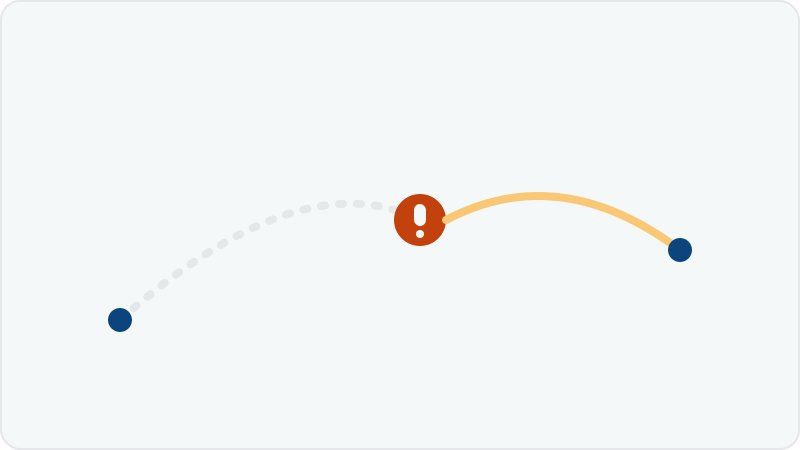
What officially makes something a flight disruption?
IATA's own interline guidance defines an Irregular Operation (IROP) as a disruption on the day of travel or the day before that causes a passenger to be unable to use their ticketed flight.
It names, without limiting the list, flight delay, cancellation, diversion due to weather, mechanical problems, landing restrictions, air traffic congestion, accidents or aircraft damage, security concerns, immigration issues, oversold flights, boarding delays and crew shortages.
More specifically, an involuntary reroute happens when an airline cancels a flight, fails to operate reasonably on schedule, fails to stop where you are ticketed, cannot honour your confirmed seat, or causes you to miss a connection you held a reservation for.
Is a schedule change I get weeks in advance the same thing?
No, and the industry has a specific line for it. Resolution 735d states that its provisions apply only if the disrupting circumstance has not occurred earlier than one day before the scheduled departure of the first affected flight.
For settlement purposes, the same framework treats a ticket reissue within two days of the original scheduled departure as genuinely involuntary, treats a reissue five or more days ahead of the new departure as not qualifying, and generally treats anything outside that two-day window as a planned schedule change rather than a real disruption.
A notice you receive a month out is handled differently from one you receive the day before flying, by design.
What am I actually owed once it qualifies?
Two options, not one you have to accept passively.
IATA's guidance states that the responsible carrier, or its ticket handler, must either arrange an involuntary refund under Resolution 737, or provide onward carriage to your ticketed destination or stopover point at no additional charge — whether that means a seat on the same airline's next flight, a seat with the carrier you were originally connecting to, or, where needed, another transportation service entirely.
The choice sits with you and the situation, not solely with whatever the gate agent offers first.
The industry's own definition of a disruption
It helps to know the actual trigger list rather than guessing whether your situation qualifies.
IATA identifies an Irregular Operation whenever a disruption on the day of travel or the day before means you cannot use the flight you were ticketed on — and the named causes span nearly everything travellers actually experience: delay, cancellation, weather diversion, mechanical fault, air traffic congestion, an oversold cabin, a boarding delay, or a crew shortage among others.
The narrower category — an involuntary reroute — is defined even more specifically: the airline cancelled the flight, failed to operate reasonably close to schedule, skipped a stop you were ticketed for, could not seat you despite a confirmed reservation, or caused you to miss a connection you held. If your situation matches one of these, you are not asking for a favour.
You are in a defined category the industry itself set rules for.
The time test: disruption or routine reschedule?
This is the detail most travellers never hear, and it is genuinely useful. Resolution 735d's protections apply only when the disrupting circumstance arose no earlier than one day before the first affected flight's scheduled departure. Move the clock back further than that, and you are usually looking at a planned schedule change, not an irregular operation — a different category with different handling.
The industry even has a concrete version of this test for paperwork: a ticket reissued within two days of the original scheduled departure is presumed genuinely involuntary; one reissued five or more days ahead of the new departure date is presumed not to qualify; and anything reissued outside that two-day window is generally treated as a planned change rather than a real disruption.
If an airline notifies you a month before departure that your flight time is moving by two hours, that sits in a different bucket than being told the night before that your flight is cancelled — and the industry's own systems are built to tell the two apart.
| Aspect | Disruption | Schedule change |
|---|---|---|
| When it happens | Close to departure | Announced weeks in advance |
| Your baseline options | Refund, or free rerouting to your destination | No baseline refund/reroute right by this rule alone |
Who is actually responsible for fixing it
Multi-airline disruptions get confusing fast, so the industry names four roles. The Original Marketing Carrier is whichever airline's code was originally on your affected flight coupon — in a codeshare, this can differ from who actually operates the aircraft. The Original Operating Carrier is the one whose flight you were scheduled on and who is responsible for whatever created the need for a change.
The Original Receiving Carrier is the one you were ticketed to connect onto. The New Operating Carrier is whoever gets selected to carry you onward once a reroute becomes necessary.
Knowing these terms changes a disruption-desk conversation. You can ask specifically which carrier caused the problem and which one is obligated to fix it, instead of accepting whichever staff member happens to be in front of you.
The two-option baseline, stated plainly
Once a situation qualifies, the responsible carrier — or a ticket handler acting for it — has two ways to meet its obligation. First, an involuntary refund under Resolution 737.
Second, onward carriage to your ticketed destination or stopover point without any additional charge to you: on the same airline's own aircraft if the interruption happened en route, on the carrier you were originally connecting to if it did not, or on any other transportation service if that is what is needed to get you there.
The obligation is to get you to where you were going, or give your money back — not to leave you stranded while staff work out logistics, and not to charge you for a seat you are entitled to at no additional cost.
What to check when it happens to you
A disruption is stressful, but a few concrete checks make it navigable:
- Match your situation against the trigger list — delay, cancellation, diversion, missed connection you held a reservation for, and so on — to confirm it is a genuine IROP rather than a routine change.
- Check the timing: if you were told about the change more than a few days before the new departure, you may be in planned-schedule-change territory rather than disruption territory, with different handling.
- Identify which carrier is the Original Operating Carrier — the one responsible for the conditions that caused your disruption — especially on a codeshare or interline itinerary.
- Remember you have two baseline options: ask explicitly about a refund under the involuntary-refund framework as an alternative to whatever rebooking is offered first.
- Onward carriage should come at no additional charge to you; if you are being asked to pay more to reach your original destination or stopover after a qualifying disruption, that is worth questioning against this baseline.
FAQ
If my flight is delayed but not cancelled, does this still apply?
Yes — the industry's IROP definition explicitly includes flight delay as a named trigger, alongside cancellation, diversion and several other causes. It does not require a full cancellation to qualify as a disruption.
Does this baseline apply the same way in every country?
This baseline is the IATA Passenger Standards Conference framework used by IATA member airlines and parties to the Multilateral Interline Traffic Agreement. It notes different standards may apply for carriers operating in or selling in the USA, and airlines can vary procedures through bilateral agreements. Statutory passenger-rights regimes in specific markets can add further entitlements.
Can the airline just pick rerouting for me instead of offering a refund?
The framework describes two ways the responsible carrier can meet its obligation — an involuntary refund, or free onward carriage — without stating that the choice belongs exclusively to the airline. If you have a preference, it is worth stating it explicitly rather than assuming only one option is on the table.
Sources
- IATA: Interline Considerations on Irregular Operations (IROP definition, Resolution 735d, carrier roles, refund/reroute obligation, INVOL test) (checked 2026-08-20)
This article states the IATA Passenger Standards Conference baseline applicable to IATA member airlines and MITA parties. Different standards may apply for carriers operating in or selling in the USA, and bilateral agreements between airlines can vary the standard procedures.
Statutory passenger-rights regimes in specific markets can grant additional entitlements on top of this baseline and are out of scope for this Global page. This article does not cover compensation amounts, care obligations, or claims procedures. Mubboo compares flight options and may earn a commission when a traveller uses a partner link; we do not sell tickets or control provider inventory.
Mubboo Flights Editorial · Reviewed by mubboo-editorial-review (2026-08-20)